13 January 2012

Cybils Wrap-up

I say "wrap-up" even though round two of the judging is just getting into gear. But for me, the work is done, and now there is nothing left to do but sit back and join those waiting to hear the announcement of the eventual winners. After months of reading, and weeks of debating, the Non-Fiction, Middle Grade and Young Adult panel chose six outstanding books as finalists. I don't envy the round two judges as they try to chose a single book to rise above the rest. Without giving away any secrets, I can say that almost everyone on they panel had to give up a title for which the felt passionately. The selection this year was excellent.

This year we have been invited to comment on "the ones that got away;" the titles that we wish had made the final cut. There were several books which I would have been happy to see make the list--books which were not on my short list but which I couldn't argue against if there was strong feeling in their favor, because they were so good. One book which missed out though, which I really would have liked to see make the list, was The Mysteries of Angkor Wat, by Richard Sobol. It's inclusion on our list was a bit of a surprise to me, because it is a picture book. There were several picture books on the list, (including The Many Faces of George Washington, which did go through as a finalist,) but they were text heavy and clearly written for a middle school or older audience. But Ankor Wat seemed young. However, we covered a wide age group, and I am assuming that is why it remained on our list and was not moved to non-fiction picture books. The picture book format served the subject matter well, giving Sobol the opportunity to share some outstanding photos on the sprawling temple. Its kid appeal was evident. Sobol introduced readers to a group of school children who sold trinkets and snacks to visitors to the temple. They befriended Sobol and shared a secret with him about the temple known only to themselves; a hook which was so surprising that I am not going to reveal here what it was, because it certainly caught me by surprise. Adults are almost non-existent in this book, other than Sobol himself, so while it is clear that these children are working to try and raise some extra money, the fact that they are playing on this ancient site completely unsupervised reveals a level of independence and freedom that American children can only wonder at.

Good luck to all the finalists! You can see a full list here.

11 January 2012

YA and Jane Austen: an obvious union?


I have started a new blog over at Wordpress, entitled From JA to YA. It will be devoted entirely to my reading of young adult Jane Austen adaptations, biographies, and anything else which purports to introduce teens to the author. I hope you will stop by and either check on my progress or join the conversation. And if you are in the Boston area on Sunday 4 November 2012, I hope you will join the Massachusetts branch of the Jane Austen Society of North America to hear me speak on the subject. Then you can say, "I knew those thoughts when they were just a blog!"

21 December 2011

Kiddie lit here, there, and everywhere

While on holiday, I've found some kiddie lit references in unusual places. I've come across Snowman toilet paper, Miffy and Mr. Men Kleenex, and Very Hungry Caterpillar cake. Fun!

15 November 2011

Author Interview: Krista Russell


New Bedford, Massachusetts, 1851

With the establishment of time and place, Krista Russell sets the stage for her debut novel, Chasing the Nightbird. This historical adventure for middle grade readers (or anyone with an interest in the history of whaling) tells the story of Lucky Valera, a fourteen year old boy who has grown up at sea, working on whaling ships with his father. After his father's death, Lucky plans to continue working as a whaler, until the appearance of an unknown step-brother, Fernando Fortuna.

A landlubber through and through, Fortuna forces Lucky into a sort of endentured servitude to pay off a debt owed him by their father. Lucky has no intention of working for his brother, particularly when he finds himself laboring in a textile mill, and is constantly scheming to get back out to sea and reconnect with the Nightbird. But encounters with Emmeline, a Quaker girl involved in the Abolitionist movement, and a fugitive slave named Daniel, force Lucky to change his plans.

As a Cape Verdean, Lucky suddenly finds himself at risk of losing his physical freedom--not simply his economic freedom--when slave catchers come to New Bedford to enforce the Fugitive Slave Act. Having always lived as a free citizen, Lucky does not identify himself with Daniel (although there is a lovely moment when Daniel sings The Drinking Gourd and Lucky mentions that sailors navigate by the Big Dipper as well.) Lucky might wish nothing more than to return to sea, but fate and circumstances conspire against him.

---------------------------------------------------------------------


Not Just For Kids: I have to start by saying how much I love the lyricism of the book's title. Did you come up with it or was it a collaboration between you and your editor? Other than the image which it creates in my mind of pursuing an actual bird (which of course isn't what the book is about, despite the ubiquitous Delph,) so much of the story is about pursuit: Daniel pursing freedom, Lucky pursuing freedom, Emmeline pursuing social justice, the slave catchers pursuing runaway slaves, Fortuna pursuing wealth, and Lucky's initial desire to actually track down and catch-up with the Nightbird. Was that a theme that you were consciously developing as you wrote the story? How did the story change from what you originally set out to write (if it changed at all?)

Krista Russell
Krista Russell: I love the title, too! I wish I could take credit for it, but it came from Jessica Alexander, my brilliant editor at Peachtree. The original title was A Following Sea, but the marketing folks at Peachtree thought it sounded too adult (on reflection, I had to agree). I tried for weeks to come up with a good alternative, but nothing sounded right. As soon as Jessica suggested Chasing the Nightbird, I knew she’d found the book’s title.

I’m not sure I was conscious of the theme of pursuit until Jessica suggested the title. I added the line where Emmeline says “Keep chasing your precious Nightbird. And good riddance!” (along with other references to the ship and where she’d be) at that time.

NJFK: Having grown up in the Boston area, I really identified with Lucky's connection to the sea. I loved the bit at the beginning, during his first day in the mill, when Lucky is trying to center himself by finding the harbor, and his distress at being so land-locked within the walls of the mill. I lived for six years in England, and 4 1/2 of those years were spent in Derby. You are probably not familiar with Derby, but it is in the Midlands, smack in the middle--about as far from the sea as you can get. That's unfortunate when you think that England is an island! Having never lived more than twenty minutes from the shore my entire life, it was an adjustment.

KR: I grew up in MA and in Kennebunkport, ME and I sooo identify with the land-locked feeling. Atlanta’s fatal flaw is that it’s a 4 hour drive from the beach :). We have lovely lakes nearby, but it’s not the same, is it?   


 NJFK: I was unaware of New Bedford's mill history (I always think of Lowell when thinking of mills.) I like how you represented the two cultures in the town: whaling culture and mill culture. While they are not necessarily in conflict with each other, as a reader I got the impression that they were rival businesses competing for the economic heart of the city. Is this true? And that clash of culture comes through in other aspects of the story; Lucky certainly looks down on "land-lubbers" at the start, and Fortuna has turned his back on the sea and the life of their father. And then there is Brisco [the mill manager] who repeatedly refers to Lucky as lazy and incompetent simply because he can't keep up with the more experienced spinners. How much research did you have to do into the two industries?

KR: I found the contrast between the whaling and textile industries really interesting and enjoyed researching both. What happened in New Bedford reflected what was happening in the US (more so in northern states) during the Industrial Revolution. The mills came to New Bedford during the golden age of whaling, but grew as whaling began to wane – finally becoming the engine driving the city’s economy.

Just as New Bedford’s identity had begun to change, our country was facing an identity crisis – illustrated by the Fugitive Slave Act of 1850. I was interested in this theme, and how our beliefs, experiences, and the groups we belong to shape our identities. 

NJFK: Did Quakers settle in New Bedford because the city was tolerant, or did New Bedford become a tolerant place because of the presence of the Quakers?

KR: Great question! Some of the founding families of New Bedford were Quaker, and more came over from Nantucket (where whaling had started) after a fire in 1846 destroyed Nantucket’s commercial district and sandbars made it hard for the increasingly larger whaleships to dock.

I had attributed New Bedford’s prominence in the abolitionist movement and its reputation as a safe haven for runaway slaves (who made up a higher percentage of the population than in New York or Boston) to Quakerism. But I found that the whaling industry and the whalemen themselves also played an important role.

I was fascinated that men who lived by the whalemen’s commandments (tongue-in-cheek though they may have been) were also active in the abolitionist movement. Although many captains and ship owners were Quaker (hard to picture them embracing the whalemen's commandments) the average sailor was not. A whaleship formed its own society (understandable given that the average whaling voyage was over 3 years) and in many ways a more egalitarian one. The work was so dangerous and the crew so dependent on one another for survival, that judgments tended to be made based on ability rather than skin color. It seemed to me that when prejudice existed it tended to be green hand (landlubber) vs. experienced sailor. Have you ever seen the show Deadliest Catch? The same dynamic exists today.

NJFK: How much research did you have to do into sailor suspicions? They are so ingrained in Lucky's philosophy. And what about the whalemen's commandments? What is their source?

KR: I did a good bit of research on sailor’s superstitions – mainly because I was intrigued by how suspicious they are (I love that a black cat is good luck to a sailor). But also because I was trying to get a feel for the world and worldview of a whaleman. The whalemen’s commandments came from Black Hands, White Sails, an amazing book about the history of African-American whalers by Patricia C. and Frederick L. McKissack. I’d been struggling with building a compelling main character, and as soon as I read the commandments I knew I’d found Lucky.

---------------------------------------------------------------------

Readers, you should go and find Lucky, too. Chasing the Nightbird is a satisfying read with strong characters and thought-provoking contrasts between freedom and slavery, land and sea, plans and destiny.

Thank you to Krista Russell for kindly answering my questions and Blue Slip Media for providing me with a copy of the ARC.

21 October 2011

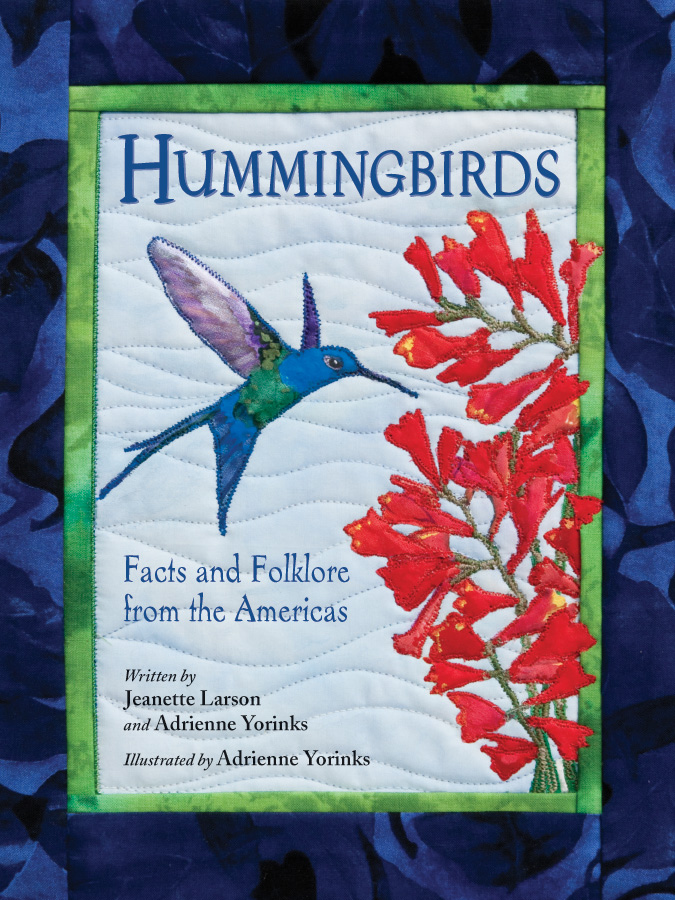
Cybils Review: Hummingbirds: Facts and Folklore from the Americas

This striking book takes a very interesting approach to the subject of hummingbirds (which, incidentally, make up the second-largest group of birds in the Americas.) It combines factual information with folktales. And quilts! When I first held this book in my hand, I felt like I was looking at one of those trick pictures with two images. When you look at the picture above, what do you see first: the subject of the book or the fantastically crafted cover? Personal prerspective might dictate how a reader is initially drawn to this book, but in the end, the merger of fact and craft is an attractive one.

At the heart of this book, as the title suggests, is the mighty hummingbird. This tiny bird, which seems to defy logic, holds a fascination not just for author Jeanette Larson, but clearly intrigued and inspired several North and South American native cultures as well. Larson starts by presenting the scientific data. Size and physical characteristics, plumage, habitat, courtship--these are some of the subjects which introduce the hummingbird to the reader. Each factual chapter is followed by a pourquoi tale--a "why" tale--which is relevant to the initial discussion. "Vocalization" is followed by Why the Hummingbird Has No Song, a Navajo tale; "Migration" is followed by the Aztec Legend Why the Hummingbird Migrates to Mexico. The hummingbird is not always a hero, such as in Why the Hummingbird Drinks Nectar, a Hitchiti Tale from the southeastern United States that bears a resemblance to The Tortoise and the Hare. But whether hero or rogue, the diversity of folktales across the length and breadth of North and South America is a testament to the ubiquity of the bird.

How the Hummingbird Got Its Colors

Special mention needs to be made of the quilts created for the book by Adrienne Yorinks. Using a combination of spot illustrations--or should I say, 'spot quilts'--to break up the scientific text, and then double page spreads, like the one above, to provide a background to the folktales, she has crafted a unique-looking book. Even the quilts themselves, which incorporate acrylic paint, collage, and photo transfers look unlike any quilts I have ever seen. They are vibrant, and at times unexpected, much like the hummingbird itself. I love the fact, mentioned in Yorinks' Art Notes, that hummingbirds can "breed with other species of hummingbirds, creating one-of-a-kind hybrids." All part of the hummingbird mystique which writers and scientists have been trying to capture since the Nazca civilization.

Nazca Lines, in Peru, created as a quilt in this book

In her introduction, Larsen says, "To fully understand any subject, it's useful to gather knowledge about it through every discipline, whether factual resources or stories." By taking this approach she has written a book which will have appeal for researchers as well as readers of tales and hopefully cross pollinate interest between the two.


08 October 2011

Why do adults read children's books?

You know, sometimes a hat is just a hat.

This recent article from The Independent references Cambridge University academic Dr. Louise Joy, who puts forth the theory that adults read childrens literature to escape the stress and demands of adult living; that they yearn for a simpler way of life, like you would find in a childrens book. Must be because being a kid is so easy, right? Her forthcoming book, Literature's Children, focuses on The Wind in the Willows, Winnie the Pooh, and the works of Tolkein, Carroll and Dahl. Uhm....21st century anyone? By that sampling I think it would be fair to surmise that adults must read childrens books out of a yearning for anytime before 1950.

I think I'll overthrow self-consciousness and have a straightforward relationship now
I'm pretty sure the millions of adults (and I don't have an exact figure on hand, so humor me on this one) who have read The Hunger Games are not hankering after anything in that book. This is my theory: grown-ups read kids book because (wait for it......) they are good! They are enjoyable. They make you think, whether it is about home cooked meals (which according to this article is a staple of The Hobbit, yet not really what I remember the book for) or the morality of twenty-six teenagers slugging it out to the death. The best childrens books do what the best adult books do--they touch readers. No age requirement--or justification--required.

07 October 2011

Cybils Nominee: Can I See Your ID: True Stories of False Identities

It's that time of year again--Cybils time! I'm a little late getting this plug in (you know--life and stuff interfering with my writing) but I wanted to mention it all the same. This will be my fourth year with the Cybils. After a year as a Round Two judge, I am back as a Round One panelist, which means a whole lot of reading and hopefully lots of great recommendations for this blog. I am serving on the Non-Fiction: Middle Grade & Young Adult panel (or NFMGYA for short.) You can see the rather impressive list of nominations here. Nominations will be accepted until the 15th of October, so there is still time to nominate your favorite NFMGYA title, or any title in ten different categories--including apps, for the first time.

I've started off with Can I See Your I.D.? True Stories of False Identities, by Chris Barton and illustrated by Paul Hoppe. Chris Barton was a Cybils winner in 2009 in the Non-Fiction Picture Book category for The Day-Glo Brothers and a 2010 Picture Book finalist with Shark vs Train. His latest book introduces ten individuals--mainly teenagers--who for one reason or another pretended to be someone else. In some cases the motivation was chutzpah, in others career advancement, and in at least two survival. Each story is told in the second person, a narrative choice I really liked because it puts the reader directly into the text. It felt like reading a Choose Your Own Adventure story, where each turn of the page might have dire consequences. It's hard not to feel a little anxious when you read the line, "There's nobody you can tell the truth to--nobody you feel you can trust." I was familiar with a few of the individuals in this book: Solomon Perel (whose amazing deception was the subject of the film "Europa, Europa") John Howard Griffin (author of Black Like Me, which I had to read in high school,) Forrest Carter (whose The Education of Little Tree caused a furor with Oprah,) and Frank W. Abagnale Jr ("Catch Me If You Can.") But the rest were a revelation.

One thing Barton does particularly well is to throw the reader directly into the deception. Along with the use of the second person narration, each fraud is already in full swing when the reader joins. Keron Thomas, the sixteen year old train spotter who decides that he would like to drive a New York city subway train for a shift, is already standing on the 207th Street station platform waiting for his carriages when the story starts. While the individuals involved might have had plenty of time to plan how they were going to carry out their impersonations, the reader does not and needs to be ready to run with the situation from the get-go. Barton does take a small step back to provide some background information, but then it is back to the business at hand, which is basically, 'will you pull this off?'

Barton's extensive research for the book, which included interviews with some of the individuals still living, shows the seriousness with which he approached this subject. At the end of each story there is a "What Happened Next" explanation where the reader discovers the consequences of the deception. In his afterword, Barton seems to be directly challenging the reader with the opening question "Who do you think you are?" As middle schoolers and young adults, they might be asking themselves that same question. But further reading seems to indicate that Barton is actually questioning himself as a writer, for having the nerve to investigate these stories. Aside from raising the morality of the rights or wrongs of tricking people, Can I See Your I.D. is essentially about having "the nerve"; the nerve to trick people who are ready to be fooled, the nerve to survive when you are condemned to die, the nerve to investigate the truth in the hearts of our neighbors, and the nerve to sell someone your story.

06 October 2011

Blog Tour: The Cheshire Cheese Cat: a Dickens of a Tale

Next year marks the 200th anniversary of the birth of Charles Dickens. This lively novel, in which Dickens plays a supporting role--but his influence is evident throughout--is a good way to get the party started. The Cheshire Cheese Cat is about a cat who loves cheese, a mouse who loves language, a crow who loves Queen and Country, and a novelist with no opening line. The story is set in Ye Olde Cheshire Cheese, an actual London pub which was frequented by some of the most distinguished writers of the Victorian era. Skilley is a Fleet Street alley cat trying to survive on fish heads and smarts. He manages to install himself as mouser at the Cheese, where he quickly strikes up an unorthodox bargain with the resident mice. The mice, led by the wordsmith Pip, will bring Skilley cheese, and he will pretend to catch them, for the benefit of the humans who are unhappy about sharing the inn with the rodents. This works for a while, until the appearance of rival cat Pinch, a truly Dickensian ruffian, who has always despised Skilley. As Skilley tries to maintain his bargain with the mice, shield them from the ruthless Pinch, protect the secret of his cheese obsession, and uncover the mysteries of the inn itself, the action culminates in several revelations, a finale involving a chaotic visit from a royal--who is not amused--and, at long last, the perfect opener.


There is precedence in childrens literature for the successful partnership of cats and mice: Samson and Arthur the church mouse; Harry Cat and Tucker Mouse in Times Square. But I think this is the first instance of  a triumvirate of cat, mouse, and monumental literary figure. No prior knowledge of Dickens is required to enjoy this book, but familiarity adds to the pleasure. Pip and Skilley talk about "our mutual friend;" Dickens mentions that he has "great expectations" for the resolution of events at the Cheese; the innkeeper's daughter, Nell, bears more than a passing resemblance to the saintly heroine from The Olde Curiosity Shop. And how about this passage? Pinch, renamed 'Oliver' by the barmaid, is deposited before a skeptical Skilley, who thinks:

"Pinch--Oliver?
Well, this was an unwelcome twist."

And for self-referential meta fans (surely there are some in the 8-12 demographic?) there is this literary trivia: Ye Olde Cheshire Cheese is alluded to in the text of A Tale of Two Cities, the book over which Dickens is laboring in The Cheshire Cheese Cat. Dickens' inability to write the perfect opening line for his new project is mentioned repeatedly, and some of his rejected attempts are deliciously, and humorously close.

Aside from the book's opening line--"He was the best of toms. He was the worst of toms."--perhaps the greatest tip of the cap to Dickens is Pip himself, who bears the name of the hero in Great Expectations. It is easy to imagine an 'a-ha' moment in the future for any young reader of this book, when they pick up Great Expectations in some high school or college literature class, and make the connection.

While having plenty of fun with Dickens (not to mention Wilkie Collins and William Thackery,) collaborative authors Carmen Agra Deedy and Randall Wright (great name for an author!) make some observations about writing as a craft. As Pip tells Skilley, "There is more to writing than tossing down a few haphazard words; words must have context." In this case, the development of the story at the Cheese is within the context of the friendship between Skilley and Pip. The success of the entire operation depends upon their camaraderie and willingness to stand by the other. There is also the observational friendship between Dickens and the animals; his journal reveals that he has taken an interest in their ways and manners, which seem unlike any he has ever witnessed before. As a fellow known for his philanthropy towards the most vulnerable members of Victorian society, it seems completely plausible that Dickens would have cared about animal welfare as well--even the welfare of one so humble as a mouse or a stray cat with a crooked tail.

While Deedy and Wright have fun with language, composing short chapters which keep the action moving along, artist Barry Moser has graced the book with portraits of the cast of characters, humans and animals alike. They complement the text with grace, humor and sometimes pathos. The Cheshire Cheese Cat is that most wonderful of packages--a clever and entertaining book which respects its audience while at the same time challenging its readers to stretch beyond a given genre (animal story, historical fiction, mystery) to discover the context of a universal story. Or, to be more precise, it is a Dickens of a tale.

--------------------------------------------------------------

The folks at Peachtree Publishing, who kindly sent me a copy of the book to preview, are clearly proud of The Cheshire Cheese Cat and have created a sublime interactive website with teacher resources, games, and further information about Ye Old Cheshire Cheese as well as Victorian London. There is also a blog which collates the stops on this blog tour. You can read all about it here. The book is available now, but I can provide a copy for one lucky reader (huzzah!) All you have to do is leave a comment and some way that I can contact you (email address, blogger id, twitter handle.) Entrants must be US residents.

Be sure to check out the other stops on The Cheshire Cheese Blog Tour:

A Word's Worth
Maestra Amanda's Bookshelf
There's a Book
Through the Looking Glass
Booktalking
Satisfaction for Insatiable Readers  
Peachtree Publishers

It is a far, far better thing to do (with apologies to Dickens!)


22 September 2011

Blog Tour: I Want My Hat Back by Jon Klassen

Would you deny this bear his hat?
Poor Bear. He's lost his hat. Then he finds his hat! The end.

A simple enough story. But read between the lines, and you will discover a book which can be appreciated as a funny read-a-loud or a sly peak through the fourth wall. I Want My Hat Back, the first picture book to have been both written and illustrated by the supremely gifted Jon Klassen, is a dead-pan pantomime starring an unlikely cast of woodland creatures. Like Pirandello's six characters in search of an author, they seem to have stumbled into a story by accident. One of them has stolen Bear's hat. One of them does not even know what a hat is. One is stuck behind a rock. Little dramas; big laughs.

It all starts with the cover. Klassen has stated that his first idea for this book was, in fact, an image in his mind for a cover. (You can read more of his insights in the Q&A at the end of this post.) Just look at that bear--he's on a mission! Focused and determined, he wants his hat back, and readers should be in no doubt as to whether or not he will find it (and woe to the one who stole it!) But once the story begins, and the bear proceeds to ask of each character his simple, unfailingly polite question--"Have you seen my hat?"--the negatives begin to pile up. Yet the bear's ignorance is the reader's bliss, because the thief of the hat is immediately evident. Once discovered, it is just a matter of giggling at each misstep until the bear finally realizes his error and does, indeed, find his hat. It is a storytelling technique which works remarkably well.

Klassen's previous experience with video (he did design work on a BAFTA nominated ad for the BBC, the film Coraline, and the video for U2's I'll Go Crazy if I Don't Go Crazy Tonight,) is evident in the theatricality of the book. In some ways, the action of the story is a direct result of the reader's perspective. The reader sees what happens, but needs to provide the context. There is no back story, no motivation, other than the intensity of the bear's desire to get his hat back. It is a sentiment to which children can instantly relate. And because they can see the hat before the bear does, you can be sure that holding this book up during either a storytime or a one-on-one reading will elicit cries of, "There it is! It's behind you!" Not to mention, plenty of scope for trying on a multitude of voices. Storytime as reader's theater!

The book weighs in at an economical 253 words, but the images speak volumes. With visual laughs for the kids, and a touch of black humor for adults, I Want My Hat Back is a cross-generational hit.


As part of this blog tour, author and illustrator Jon Klassen kindly took some time to answer a few questions.  


NJFK: In creating this book, did you have an image first or the story? Did you enjoy the freedom of creating both, rather than working from a story written by someone else?


JK: I had the idea for the cover first, but not the character or the story for a little while. Just the title, and somebody not wearing a hat. I did enjoy working on both the writing and the pictures, though I was nervous about it, because I don't usually write things. There are less ways to hide in writing than there are in illustration. But when it became just dialogue, I got more comfortable because it's less formal.
I was also glad to work on something very simple. When you get something from someone else, it's often harder to make it simple.   

NJFK: Despite the fact that little seems to happen in the story, there is a sense of theatricality because of the perspective of the audience. Reading the book reminded me of watching a pantomime (“He’s behind you!”) Did your experience of working with film and video influence the creation of this book in any way?


JK: Yes! I'm glad you noticed that. Because I was nervous about the writing, and also because I like drawing characters that aren't doing very much, I wanted to try and make it seem as though it was a badly rehearsed play with animals who were sort of brought in for the day to read these lines. That's why they are looking at the audience instead of each other, which is how the bear misses seeing the hat early on. Later, once he's found out what has happened, it's like the bear forgets he's in a play and gets as mad as he would if this had happened to him in real life and goes and does what a bear would do.

I think the way the end is done is a little more like a storyboard from a film instead of maybe how a book would be. It's hard to stop thinking about stories that way if you've been doing it for a while.
  
Author and illustrator Jon Klassen
NJFK: How is a book created both digitally and in Chinese ink? One process seems modern and the other traditional.

JK: Those two things are how I like to work best. I like working with traditional mediums at first, to give a looseness to things, and then bring what's been done into the computer to work over it and tighten it up. It's nice because you can make all sorts of mistakes and experiments with the traditional materials and know you still have that last stage to use whatever you're doing. In this case all the characters and plants were done in silhouette with chinese ink on paper, and then scanned in and the color and smaller details, like eyes and other features, were added digitally.   

NJFK: Will there be a sequel involving a blue, round hat, by any chance?

JK: There might be a blue hat, though I'm pretty happy with the shape of the red one. I might keep it pointy like that.  

NJFK: And finally, I have to ask--what was it like working with U2?!

JK: Well I didn't get to meet them or anything. David O'Reilly, the director, got to meet them afterward because he was working from Europe and they came through, and it really was David's video. But it was still pretty surreal sending them illustrations and getting approval and stuff. It was such a small production, it was weird knowing it was for this huge band that we'd all grown up with. They liked the video though! They even let us make the cover for the single afterward!

A big thank you to Jon Klassen for the interview, and to Candlewick Press for providing me with a copy of the book. Be sure to visit the other stops on the (global!) tour for more interviews with Klassen:

Tuesday, Sept. 20 – UK: Playing by the Book
Wednesday, Sept. 21 - AUS: Kids' Book Capers
Thursday, Sept. 22 - US: Not Just for Kids
Friday, Sept. 23 – UK: Bringing Up Charlie
Saturday, Sept. 24 - AUS: My Book Corner
Sunday, Sept. 25 – UK: Wahm Bham
Monday, Sept. 26 - Canada: Pickle Me This
Tuesday, Sept. 27 - US: There's a Book
Wednesday, Sept. 28 - AUS: My Little Bookcase
Thursday, Sept. 29 - US: Chris Rettstatt


16 September 2011

More Kiddielit love for Ted Williams

I've been obsessing about the amount of attention Ted Williams gets within the realm of children's literature. Must be all those pin-striped covers I've been forced to stock over the years. I was well pleased to read Fred Bowen's No Easy Way , and I thoroughly enjoyed The Unforgettable Season by Phil Bildner, even if Williams did have to share the book with Joe Dimaggio. Now, I can look forward to two more books recognizing the accomplishments of the Splendid Splinter, both as a ball player and as a man.

October sees the release of Soldier Athletes, the third installment in Glen Stout's highly readable "Good Sports" series (shameless plug--mine is the Booklist review beneath Baseball Heroes.) Four athletes are featured, so of course there is a profile about Ted Williams and his distinguished career as a pilot during both World War II and the Korean War.

Then there is There Goes Ted Williams: the Greatest Hitter Who Ever Lived by author and illustrator Matt Tavares. Tavares has already proven his Red Sox cred with Zachary's Ball, and his picture book biography Henry Aaron's Dream is not to be missed. There Goes Ted Williams looks to be really special. You can see get a peek at it here, but you'll have to wait until 2012 to get your hands on the book.

Last but not least, Dan Gutman is finally bringing Ted Williams into the Baseball Card Adventures fold with Ted and Me. And just in time for the 100th anniversary of Fenway Park. Now, I can't take credit for this, of course, but I did write that open letter to Dan Gutman all those years ago...... However it came about, Gutman's latest is a welcome addition.

Add This

LinkWithin

Blog Widget by LinkWithin