24 September 2012

Best big word in a picture book

That honor, at least this week, will have to go to "malfeasance", from Ian Falconer's Olivia and the Fairy Princesses. As in: "I [Olivia] could be a reporter and expose corporate malfeasance."

I have to confess--I can't even pronounce 'malfeasance'.

Am I the only one who thinks that Olivia will grow up to be Harriet the Spy?

18 September 2012

Bring on the 2012 Cybils!


I'm excited and honored to once again be participating in the Children's and Young Adult Bloggers Literary Awards (but known as the Cybils among friends.) This will be my 5th year acting as a judge, my 4th year in non-fiction, my 2nd year reading for the Non-Fiction Middle Grade Young Adult (NFMG/YA) category, and my 1st year as a second-round judge in the category. Phew! I think that covered all the bases.

Let's be honest--the Cybils is a labor of love: it takes an enormous amount of time to read all the books which are nominated (this cannot be understated!) by dedicated individuals who probably read a lot anyway. Still! It's a ton of books (or apps, for those on the Book App committees.) It's certainly good for the circulation statistics at my local library, as I start requesting copies of the nominated titles. But to finally have a decent excuse to ignore chores and tackle all the great books I've been eyeballing all year ("sorry hon--no clean laundry today. Committee work!") is liberating.

So come on--help me avoid housework! Give me lots of books to read! Nominate your favorite childrens and young adult books in a variety of categories. Nominations open 1 October 2012 and will remain open until 15 October 2012. You can read the Cybils FAQ here to get the nitty-gritty on the nominating process. Then be sure to scour those nomination lists and marvel at all the wonderful books that have been published this past year.

13 September 2012

The Wolves of Willoughby Chase


My review of The Wolves of Willoughby Chase by Joan Aiken is today's Retro Review over at the Nerdy Book Club. Check it out!


12 September 2012

Appropos of nothing

So....who watched Saturday's new Doctor Who episode? I did. And I immediately thought of every one's favorite Time Lord when this arrived in Monday's new book order:
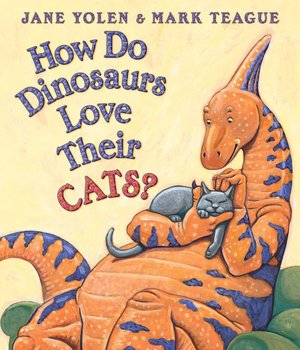
You can't go wrong with dinosaurs in a public library. Dinosaur books come second only to Captain Underpants replacement copies in my book order hierarchy. I personally am not big on dinosaurs. But I have a few favorites. In no particular order:

A sentimental favorite, because it was one of the first books I was able to read on my own.


OK--I've not read this one. But I love the retro theme that's rocking the cover.


Here's one I have read--repeatedly. The idea of receiving dinosaurs instead of lollipops when out on errands with mum seems immensely satisfying. As a child I probably would have preferred ponies to dinosaurs-----but still! Free pets!


 According to this cover, I'd say they descended from Heaven! I like the original approach of this title. Folks are usually more interested in where the dinosaurs went.


 :)

What is your favorite dinosaur book?

16 June 2012

Over at "From JA to YA............"

.........I'm taking at a look at The Dashwood Sisters' Secrets of Love by Rosie Rushton, the first book in her Jane Austen in the 21st Century series.

16 May 2012

Over at "From JA to YA".......

........I'm taking a look at the PBS series Wishbone and their riff on Pride and Prejudice, "Furst Impressions."

08 May 2012

Over at "From JA to YA"......

.........I am examining For Darkness Shows the Stars, by Diana Peterfreund. Set for a June 2012 release, the novel is an original and successful adaptation of Jane Austen's Persuasuison. Check it out here.

04 May 2012

Rave Reviews: Okay for Now by Gary D. Schmidt

I know I'm late for the lovefest for this book, but I say 'better late than never.' I am so glad I read it. I really enjoyed The Wednesday Wars, in which the character of Doug Sweiteck first appears, but I have to admit that I don't remember much about the story. However, I am confident there will be no memory lapses with Okay for Now.  And the credit for that goes to John James Audubon.

Like Doug, I had my own Audubon epiphany almost 20 years ago, when I went to see an exhibit of his Birds of America at the Boston Museum of Fine Arts. I had no expectations, just an hour's lunchtime to kill between classes at Simmons. I figured I knew birds. They're everywhere; see them all the time. Well as Doug would say, I was a chump. I stood in front of those paintings, which were much larger than I had anticipated, for one thing, and was blown away by the strength and down-right drama in them. Do you know how that feels? Doug Sweiteck does.

Doug's story is, as the dust jacket says, about "the power of art and story over despair and loss." That sums up the plot pretty well; Doug is the youngest child in a blue-collar family in 1969 small-town New York. His father is an abusive lout, his oldest brother, Lucas, returns from Vietnam a blind amputee, and his other brother, Christopher, is following in the footsteps of the dad. His mother is a beautiful soul, and you wonder how she ever got roped into this existence. Doug has nothing going for him except himself. And, thanks to the local library, (hurrah!) John James Audubon. The library has a copy of the Birds of America, which they display on the top floor--and which the town draws from "like a bank," razoring out prints and selling them each time money is needed or some good doobie merits recognition. It is an act of cultural vandalism which Doug is insightful enough to recognize. As his relationship with the paintings becomes stronger, he resolves to rectify this wrong, just as he is fixing so many other broken things in his life.

The nature of Doug's relationships with the prints is two-fold. As a budding artist, he wants to draw them himself; with the help of one of the librarians he learns how to capture and imitate Audubon's techniques. But just as importantly, Doug learns to read the paintings. And these readings stay with him as he interacts with his family, his classmates, and his neighbors. There is a wonderful "pay it forward" feel to the book, without the piety of the sentiment. A magnificent example of this is in Doug's relationship with his PE teacher, Coach Reed, a man who has spent the better part of the book bullying Doug. At this point Doug is working on copying The Forked-Tailed Petrel.


He has also discovered a notebook of pictures that Coach Reed has drawn of his time in Vietnam; nightmarish images which look like Lucas' dreams sound. With the two petrels in mind, buffeting on the wind moments before their paths cross, Doug sees and seizes an opportunity to help two men--one he loves and one he despises--help each other heal.

The final triumph of the paintings is in Doug's reading of The Arctic Tern, the bird which opens and closes the book (the chapters are named after individual prints.) Despite the tone of the title, which suggests that Doug has settled into an acceptable existence, everything is much better than okay. Not necessarily fixed, but full of promise. And at the center of that promise is Doug, with his artist's heart and his artist's eye, looking for the next spectacular thing that is going to come into his life.

27 April 2012

Celebrating Fenway Park: Ted and Me by Dan Gutman

2012 marks the 100th birthday of Fenway Park, home of the Boston Red Sox, and children's publishing is on the ball. There have been some lovely children's books published this year, focusing on the park and the team, and I plan to read and review them all!

I'm starting with Dan Gutman's Ted and Me, which is the eleventh volume in Gutman's Baseball Card Adventure series. The premise of the series is simple: Joe "Stosh" Stoshack is an every-boy with a remarkable gift; he can travel through time by touching old baseball cards. On his adventures he has met 10 famous ball players, including Honus Wagner, Shoeless Joe Jackson, and Satchel Paige. I have been campaigning for an adventure with Ted Williams almost since the day he died. And it seems that Mr. Gutman and I are of the same mind, because here, just in time for Fenway's 100th birthday, is the book. (Spoilers ahead!)

The best thing about the Baseball Card adventures is the spirit of fun in which they are written. The science involved is pretty vague, and the ease with which Stosh incorporates himself into the lives of the players he meets is suspect (I'm guessing we will never see "Ty and Me".) But who cares--it's a little boy meeting baseball legends! That's a formula that's hard to resist. However, the initial suspension of belief required at the start of Ted and Me is whopping. The FBI are aware of Stosh's ability, and they want him to travel back in time to warn FDR about the attack on Pearl Harbor. Stopping the attack on Pearl Harbor is a time-travel chestnut--one of the greatest "what-ifs" out there in speculative fiction, so it's not a bad starting point for a story about a boy meeting not just a great ballplayer, but a true American patriot as well (which, Williams, with his distinguished military career, was.) But the fact that the FBI don't want to commandeer Stosh and take him back to headquarters to run tests on him, or anything sinister like that, but instead simply send a polite agent to his house to talk with him and his mom about it--that's difficult to swallow.

But at this point, Gutman plays a great trick on the readers which derails the issue--he sends Stosh to the wrong Ted Williams. The FBI may have done their homework about Stosh's talent, but they don't know diddly about baseball cards. They give Stosh a Ted Williams card from 1952. Consequently, Stosh finds himself in the back of Williams' bomber as he's flying a mission over what is now North Korea.  Wrong war! Pearl Harbor is long gone, Roosevelt's been dead for 8 years, and--oh yeah--Williams' plane has been hit. Just before they crash land, Stosh gets himself back to his own time. It's a great scene, full of action and swears (which Gutman wisely replaces with "!@#$%") and a full-frontal, in your face introduction to Ted Williams and his larger than life personality.

When Stosh does connects with the correct Williams, the baseball finally takes over. It is September 27, 1941. Before Stosh can complete his Pearl Harbor mission there is the little matter of baseball history: the next day Ted Williams will go 6-8 in a double header against the Philadelphia Athletics. He will finish the year with a .406 batting average, a feat which has not been equaled to this day. Stosh is particularly careful not to interfere with that, especially since part two of his "warn about Pearl Harbor" plan is to convince Williams not to join the military so that he can reclaim the five years lost to active service and potentially improve his lifetime statistics.

I've said that Gutman never moralizes in these books, but that doesn't mean that he is not trying to reveal a greater point. When Stosh encounters these baseball greats, it's always the right person at the right time. He certainly learns lessons that he can apply to his current situation. In this case, Stosh and his little league team are fresh from defeat in the Little League World Series. Despite his thrill about being involved, the reader sees a hesitancy in Stosh. He feels that he has leveled off as a player, a .270 hitter with a decent arm. He's good enough, but will probably not get any better. He is so preoccupied with not messing up on TV, he turns down an offer to carry the team's American flag during the opening ceremony, and he is unhappy to be in the position to make the final out of the game. Rather than rising to any challenges, he settles back and accepts defeat. This is clearly the perfect time to meet Ted Williams, a man who never settled for being anything but the greatest at everything he put his hand to.

Ted Williams' number 9 was retired by the Red Sox
Ted Williams is not an easy character to recreate for children. For starters, there is the matter of his language. This is not a man who spoke in "gosh's" and "darn's." He swore. Prolifically. This points to the fact that if he is going to be central to one's book, he can't be watered down. Gutman rather humorously addresses this in his "Note to Readers", and then just gets on with it. Williams was a human of striking contradictions. For as gruff and brash as he was, he was also immensely generous with his money, his time, and his compassion. Gutman gets mega-kudos for mentioning Williams' work with the Jimmy Fund. But of course, how could he possibly write a book about Williams and not mention it? It is one of the many reasons he is legendary in the city of Boston.

All in all, as a reader and a Sox fan, I thoroughly enjoyed Ted and Me. I just have one complaint--Stosh never makes it to Fenway Park! History dictates that Williams set his record in Philly, so of course that it where Stosh lands. And then they head for Washington DC, to warn the president, a mission which is--obviously--not completed. I understand that the structure of the story sends them away from Boston instead of to it, but I was looking forward to Stosh checking out my ballpark. But, as Stosh himself admits, these trips through time never turn out as he plans, and for this reader, the same holds true.

Stosh started the story knowing very little about Ted Williams. But by the end, his understanding of the man's legacy is firm. Stosh has grown up during the steroid era, as have many of his readers. He sums everything up quite well as he is sitting in Shibe Park, watching what is a meaningless game of baseball, with no play-off implications--but huge historical ramifications.

"Over the next 70 years, I knew, Babe Ruth's home run records would fall. Lou Gehrig's consecutive game streak would be broken. Humans would go to the moon, invent rock and roll, and create the internet; and the world would change in so many ways.
But nobody would ever hit .400 again."

07 April 2012

Letting my 11 year old read The Hunger Games

Long-time readers of this blog, and people who know me well, know that there's no "letting" involved when it comes to reading. My philosophy when it comes to children and books is, "let them read what they want." Experience has taught me that children can be trusted to put down a book when it is too advanced or difficult or upsetting for them. In fact, experience has taught me that most "problems" with childrens books are more about adult hang-ups (my own included) than about an issue for the child. When The Hunger Games was originally published, I put it in the YA department, which in this library is grades 9-12. I would occasionally get middle school readers who would ask for it. Now, thanks to the success of the film, I have 8 and 9 year olds looking for the book. I've also had parents seeking it out for their children, explaining (as if any explanation were needed) that their child could handle it. Hey--we don't judge in this library! Although the parent that asked me for "that hungry book" for their fifth grader did leave me wondering if she was aware of the book's premise. When a chaperon on a pre-school visit pulled me aside earlier this week and asked how I felt about the book, and was it safe for her 11 year old boy, it was clear to me that I will be talking Hunger Games for most of the spring.

I, too, have an 11 year old at home; a daughter I used to think was a reluctant reader, until it finally dawned on me that she just reads differently than I do (more on that later.) She has been reading Forge by Laurie Halse Anderson for her social studies unit on the American Revolution and hating it every step of the way. Her objection--too graphic. She told me (repeatedly) about a scene where a man is shot dead, and then proceeded to describe how the blood looked on the ground. She didn't like it. It upset her. She even told me she didn't think "little kids" (she is in fifth grade, so she is selectively little when the occasion suits!) should be forced to read the book, even for school (a point she later made to her teachers in a written response she was required to write about the book.)

And then The Hunger Games trailers started to appear. And she asked me if she could see the movie. I am not nearly as permissive about movies as I am about books. I told her no. My daughter, being clever, immediately attacked my weak spot. "What if I read the book?"

I'd still read it!
With the Forge experience still fresh in my mind I pointed out that The Hunger Games is more graphic and contextually far more disturbing. It was a point taken. She had not liked reading Forge. She was a little worried about reading The Hunger Games and being scared. But she really wanted to see the movie--a PG-13 movie about kids fighting to the death, which she knew would be an automatic 'no' unless there were some pretty exceptional circumstances. For my part, I wanted my daughter to love a book that I love--an intelligent, magnificent piece of dystopian fiction with a strong heroine and a compelling plot which reveals more and more with each reading. But I didn't want her to get nightmares, or be so deterred if she wasn't ready for it that she then never picked it up again (I suspect this was her experience with Harry Potter.) So we tried to make the book as safe as possible for her. I started reading it to her, a chapter a night, so that she could ask all the questions she wanted (so long as they weren't spoilers!) and not confront the harsher scenes on her own. Then, when we were done, if she still wanted to see the film, I would take her.

That arrangement lasted about a week, at which point she ripped the book from my hands and proceeded to finish it herself. She loved it. She marched down stairs when she finished it and decreed it "the best book ever!" No Forge ill-effects whatsoever.

And this is where I get to the part where I contemplate the different types of readers we are, my daughter and I. I read like my life depends on it. I'm not joking when I say I worry about the books I'm not reading, the great books which will slip through my fingers simply because I don't have the time to read them all. When I have spare time on my hands, my first thought is to read. Every other form of entertainment is balanced against whether or not I want to take the time away from a book. This is possibly unhealthy, I admit it. But it's indicative about how I feel about books.

My daughter likes to read, but usually only at bedtime. Rare is the occasion when she will choose to read instead of watch TV or play on the computer or go outside or simply daydream. In fact, there are times when I feel that she will do anything to avoid picking up a book if it's not during that last hour or so before bed. But when she does read, she has a pantheon of go-to books that she constantly revisits. For her, reading is not so much about the new experience as it is about comforting familiarity. She will sample new books when she has to, usually for school, or on the recommendation of a friend. Sometimes she will even take my advice and try something I think she will like. The Hunger Games (and now Catching Fire, which she is zipping through) is that rare book where she did drop all else to read it. And I know that it will enter her inner sanctum of beloved books and be read repeatedly. I know that what she doesn't understand now at 11 will hit her differently when she is 13, 15, 18--when she is revisiting the Capital and the Districts and seeing a story she thought she knew so well take on new meaning because she is at a different point in her life than she is now. That is an incredible gift that Suzanne Collins has given to my daughter.

So yes, I "let" my daughter read The Hunger Games. My parental concerns gave way to her wishes, and in the end she proved me correct to trust my librarian instincts. Where Forge fumbled, Katniss triumphed. Score one for the freedom to read what you want.

Add This

LinkWithin

Blog Widget by LinkWithin